



Managing front and back yards separately with robot mowers has become seamless through RTK-GPS technology and virtual corridor systems. Modern wireless mowers like Lymow eliminate boundary wire installation while enabling precise multi-zone navigation. These advanced systems allow homeowners to map distinct zones, create connecting pathways between separated areas, and schedule customized mowing routines for each space—all through intuitive smartphone apps. The technology works through virtual boundaries and channel pathways that guide mowers between zones automatically, with options for manual transfer when areas are completely disconnected.
Understanding Multi-Zone Robot Mower Technology
Multi-zone management refers to a robot mower’s ability to maintain separate lawn areas as distinct zones with individual settings. This capability addresses the common suburban challenge where front yards, backyards, and side lawns require different maintenance due to varying sunlight exposure, grass growth rates, and usage patterns.
Two primary navigation approaches enable this functionality:
Wired Systems Use physical boundary wires buried around perimeter edges and guide wires connecting zones. These require 4–6 hours of installation time and offer proven reliability at lower upfront costs. However, they lack flexibility for landscape changes and demand significant initial labor.
Wireless RTK-VSLAM Systems (e.g., Lymow): Utilize satellite positioning with base station correction signals, achieving ±2cm accuracy. Virtual boundaries are drawn through apps in 15–20 minutes, with complete adaptability for seasonal layout adjustments. These systems eliminate wire installation entirely.
| Feature | Wired Systems | RTK Wireless (Lymow) |
| Installation Time | 4-6 hours | 15-20 minutes |
| Boundary Flexibility | Fixed (requires rewiring) | Fully adjustable via app |
| Positioning Accuracy | Wire-dependent | ±2cm RTK precision |
| Multi-Zone Capacity | 3-5 zones typical | Up to 80 zones |
| Upfront Cost | $1,500-$3,100 total | $2,400-$3,500 |
The technological shift toward wireless systems reflects homeowner demand for installation simplicity and operational flexibility, particularly for properties with complex layouts requiring frequent zone adjustments.
Method 1: Virtual Corridor Systems for Connected Yards
For properties where front and back yards connect through side pathways, driveways, or narrow passages, virtual corridor technology provides automated zone transitions. This approach allows mowers to navigate between separated areas without manual intervention.
How Lymow Simplifies Corridor Navigation:
The Lymow system creates corridors by recording manual drive-throughs via app remote control. Users guide the mower from one zone to another once, and the system saves this path as a permanent corridor route. During autonomous operation, the mower automatically disengages its blades when entering corridors for safety, then reactivates them upon reaching the destination zone.
With the Lymow One Plus, you can manage up to 80 separate zones with a massive 15-acre map storage capacity. Each area supports independent precision-adjustable cutting heights (from 1.2 to 4.0 inches), mowing speeds, and pattern configurations.
Scheduling Optimization for Connected Zones:
Effective multi-zone scheduling accounts for environmental differences. Front yards often benefit from twice-weekly mowing due to higher visibility and faster growth from full sun exposure, while shaded backyards may only require weekly maintenance. The Lymow app enables zone-specific schedules, allowing homeowners to assign different frequencies and timing to each area based on actual growth patterns rather than uniform property-wide routines..
Method 2: Manual Transfer for Disconnected Properties
When front and back yards are completely separated by structures with no connecting passage, manual transfer provides a practical multi-zone solution.
Manual Transfer Workflow:
- 1. Primary zone completion: Mower completes the scheduled front yard maintenance and returns to the charging station.
- 2. User relocation: Homeowner moves the mower to the backyard (the Lymow One Plus weighs 35.6 kg / 78.5 lbs±1 lb with the battery).
- 3. Zone activation: App switches to backyard map profile
- 4. Autonomous operation: Mower executes backyard routine independently
RTK Base Station Placement for Optimal Multi-Zone Coverage
RTK-GPS systems require strategic base station positioning to maintain correction signal strength across all zones. The base station broadcasts real-time positioning adjustments that enable centimeter-level accuracy, making placement critical for multi-zone reliability.
Lymow Base Station Specifications:
- Signal range: Effective coverage for properties where zones are within operational range (specific distance not specified in available documentation)
- Placement flexibility: Can be elevated on poles or structures for improved line-of-sight
- GPS interference mitigation: Strategic positioning compensates for partial tree cover or building obstruction
Optimal Placement Guidelines:
For properties with front and back yards, central positioning between zones maximizes coverage. A base station mounted on a garage roof facing the backyard can typically maintain signal strength for front yard zones up to 80m away, assuming minimal structural interference.
Signal Strength Considerations:
- Clear sky view: The base station requires an unobstructed view of the southern sky (Northern Hemisphere) for satellite reception.
- Obstacle avoidance: Metal roofing, dense tree canopies, and tall structures create GPS “shadow zones.”
- Corridor coverage: Narrow side passages between buildings may experience signal degradation—test corridor navigation during initial setup.
The Lymow system utilizes RTK-VSLAM integrated navigation technology, combining visual semantics and 3D recovery technology to understand the surrounding environment and detect obstacles.
Zone-Specific Customization Capabilities
The Lymow system utilizes RTK-VSLAM integrated navigation technology, combining visual semantics and 3D recovery technology to understand the surrounding environment and detect obstacles.
Lymow Multi-Zone Customization Options:
Modern multi-zone systems enable independent operational parameters for each mapped area, optimizing performance for varying grass conditions and usage patterns. This granular control transforms robot mowers from simple automated tools into adaptive lawn management systems.
Cutting Height Adjustment (1.2-4 inches per zone): 2–2.5 inches for a manicured front yard; 3–3.5 inches for drought resistance in backyards; 2.5–3 inches for high-traffic durability.
Mowing Pattern Configuration: Parallel lines for formal front yard aesthetics; diamond/grid patterns for visual interest.
Speed and Frequency Settings: 2–3 sessions weekly at standard speed for high-growth zones; weekly maintenance at reduced speed for shaded areas to conserve battery; increased frequency during spring growth spurts.
The Lymow app interface allows users to modify these parameters without remapping, enabling real-time adjustments based on weather patterns, seasonal growth changes, or landscape modifications. For example, a homeowner can temporarily increase backyard cutting height during summer drought stress while maintaining front yard appearance standards—all through simple app toggles.
Slope Management in Multi-Zone Properties
Terrain variation between front and back yards demands robust slope-handling capabilities, particularly for properties with elevation changes or hillside passages. Standard robot mowers manage 15–20° inclines, while advanced AWD systems handle steeper grades.
Lymow One Plus Slope Performance:
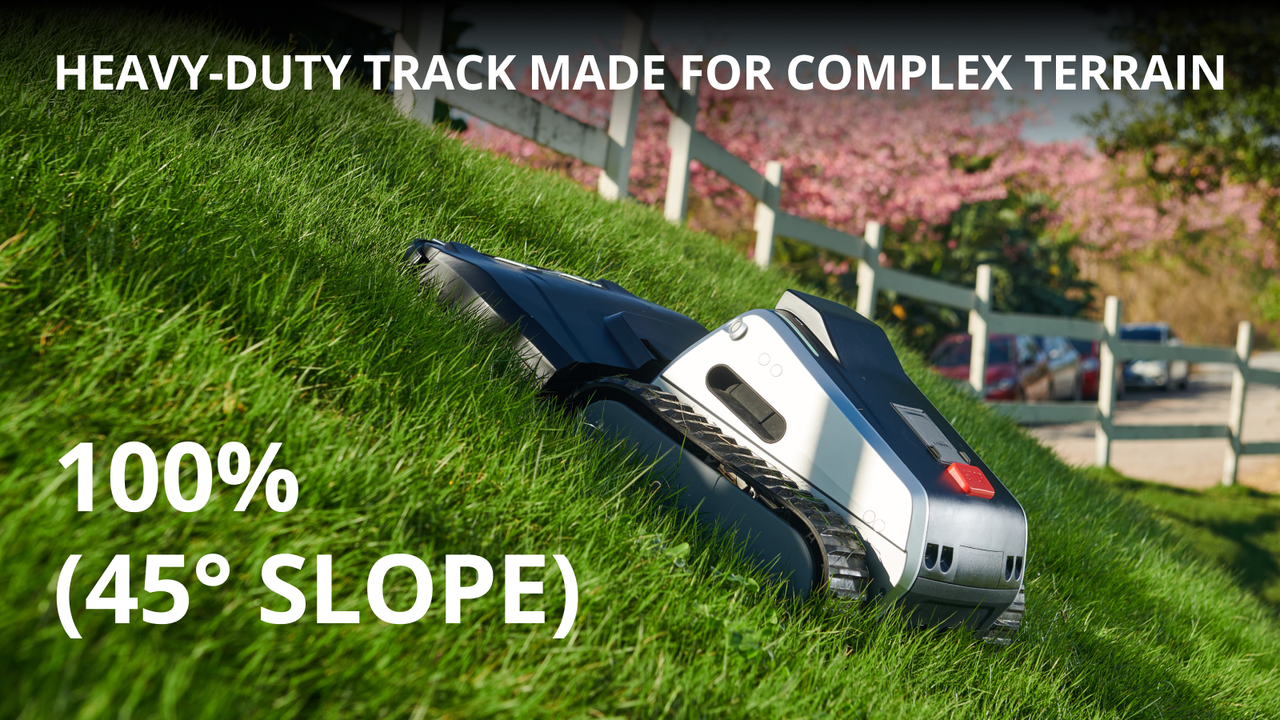
- Maximum gradient: 45° (100% grade) in passage corridors
- Tracked tread system: Continuous rubber tracks provide superior traction compared to wheeled competitors.
- Weight distribution: 35.6 kg mass with a low center of gravity prevents rollback on inclines.
Properties with elevated backyards accessed via sloped driveways benefit from high-capacity slope systems. A typical suburban layout might feature a flat front yard (0–5° grade) connected to a hillside backyard (15–25° grade) via a 10–15° driveway passage. The Lymow system’s 45° capability ensures reliable corridor navigation regardless of pathway steepness.
Safety Considerations:
Wet grass reduces traction—schedule mowing during dry conditions for sloped zones.
Steep cross-slopes (side-to-side tilt) pose a greater rollover risk than direct ascents.
Regular tread inspection maintains grip performance across seasons.
Troubleshooting Common Multi-Zone Challenges
GPS Signal Loss in Passages: Narrow corridors between buildings can create temporary satellite signal disruption. The Lymow system’s RTK base station correction compensates for this through continuous radio-frequency positioning data. If signal loss persists, elevate the base station or relocate it to maintain line-of-sight with corridor pathways.
Corridor Navigation Failures: Mowers stopping mid-passage typically indicate width verification issues. Measure passage width at the narrowest point—Lymow requires minimum 0.8m clearance. Remove temporary obstacles (hoses, toys, debris) that reduce effective passage width below specifications.
Battery Depletion During Zone Transitions: Mowers failing to complete multi-zone routines often have charging stations positioned too far from corridor entry points. Optimal placement locates stations within 10-15m of passage access, minimizing transit battery consumption before zone work begins.
Mapping Boundary Errors: Zone edges appearing irregular or overlapping require re-calibration. In the Lymow app, use the boundary editing function to adjust perimeter lines without complete remapping—particularly useful for minor seasonal landscape changes like expanded garden beds or new hardscaping.
App Connectivity Issues: Remote monitoring beyond Bluetooth range (20-50m) requires stable WiFi or 4G coverage. The Lymow One Plus supports Bluetooth, 2.4GHz WiFi, and 4G LTE for monitoring and control from anywhere.
Cost Analysis: Wire-Free Multi-Zone Investment
Total Ownership Comparison (3-Year Period):
Traditional Wired System: - Mower unit: $1,800-$2,500 - Boundary wire kit: $150-$250 - Installation labor (DIY): 6-8 hours - Wire replacement/repair: $50-$100 annually - 3-year total: $2,150-$3,050
RTK Wireless System (Lymow): - Complete system: $2,400-$2,800 - No installation materials needed - Setup time: 15-20 minutes - Minimal maintenance costs - 3-year total: $2,400-$2,800
ROI vs Professional Lawn Service:
Average professional lawn care costs $150-$300 monthly ($1,800-$3,600 annually) for 0.5-acre properties with separate front/back yards. A Lymow system achieves full ROI in 8-18 months compared to ongoing service contracts, while providing: - Consistent maintenance (2-3x weekly vs biweekly professional visits) - Mulching benefits (clippings return nutrients to soil) - Flexible scheduling (early morning/evening operation) - No recurring seasonal contracts
The wireless approach eliminates the $200-$400 wire installation cost differential, making RTK systems like Lymow cost-competitive with wired alternatives when accounting for setup labour and long-term flexibility value.
FAQ
Q: How wide does the connecting passage need to be for multi-zone navigation?
A: Most robot mowers require a minimum 1m (3.3 feet) passage width for reliable corridor navigation. The Lymow One Plus reduces this requirement to 0.8m (2.6 feet), providing greater flexibility for properties with narrow side yards or tight pathways between structures.
Q: Do I need separate charging stations for disconnected front and back yards?
A: Not necessarily. If zones connect via passages, one charging station suffices—the mower navigates between areas automatically. For completely disconnected yards, you can either manually transfer the mower between zones (carrying it 1-2 times weekly) or install a second charging station ($200-$250) in the alternate zone for fully automated operation.
Q: How long does multi-zone setup actually take?
A: Wired systems require 4-6 hours for boundary wire burial and guide wire installation. RTK-VSLAM systems like Lymow complete initial zone mapping in 15-20 minutes through app-guided boundary drawing and corridor recording. Adding additional zones or adjusting boundaries takes 2-5 minutes per modification.
Transform Your Multi-Zone Lawn Care Today
Managing separate front and back yards no longer requires wire installation, manual repositioning, or compromised automation. RTK-GPS technology has matured into a reliable, cost-effective solution for complex property layouts, with systems like Lymow delivering professional-grade precision at accessible price points.
Ready to eliminate weekly mowing routines while achieving consistent, customized results across all your lawn zones? Explore the Lymow One Plus multi-zone capabilities and discover how 80-zone capacity, 0.8m passage navigation, and intuitive app control can transform your property maintenance approach. Visit lymow.com to view detailed specifications, watch corridor setup tutorials, and locate authorized dealers in your area.


Leave a comment
This site is protected by hCaptcha and the hCaptcha Privacy Policy and Terms of Service apply.